The Microsoft Miracle: How Satya Nadella Changed Everything
August 31, 2026
Worship Stance
September 13, 2026The Founder’s Trap: Why Your Business Can’t Grow Past You
I remember the exact feeling of being the only person in my company who could answer a particular customer’s toughest question — and being proud of it. It felt like proof I was indispensable. It took me years to understand it was actually proof I was the ceiling. Every business I’ve started, in every industry I’ve touched — real estate, energy, media, legal services, travel, solar — has gone through the same early season: the founder as hero, the one person who can fix anything, close anything, explain anything, negotiate anything. And every one of those businesses hit a wall the moment growth required more of me than I had hours in the day to give. The wall wasn’t the market. The wall was me.
If you’re an owner reading this and nodding along, I want to name what’s happening to you, because it has a name, it’s more common than you think, and it’s survivable — but only if you’re willing to admit you’re the problem before the business forces you to.
The Entrepreneurial Seizure
Michael Gerber, in The E-Myth Revisited, calls it the “Entrepreneurial Seizure.” Most business owners aren’t entrepreneurs in the textbook sense — they’re technicians who got tired of working for someone else and decided to do the technical work on their own account. A great electrician starts an electrical company. A great salesperson starts a sales agency. A great mechanic opens a garage. The technical skill that got them started is real, and it’s what gave them the confidence to leap. But it never taught them how to build a system that doesn’t depend on them personally, because the technical work and the work of building a business are two entirely different disciplines that happen to share a founder.
So they end up trapped working in the business instead of on it, becoming the bottleneck for every decision — the one who has to approve the estimate, review the contract, take the angry customer call, sign off on every hire, personally inspect the finished job. Growth doesn’t relieve that bottleneck. Growth makes it dramatically worse, because more revenue means more decisions funneling through the same single point of failure. I’ve watched owners hit six and seven figures in revenue and still be personally approving expense reports under a hundred dollars, because the habit of being the final check on everything never got broken — it just scaled up alongside the business, straining under its own weight.
Jethro’s Warning
This is not a new problem, and it doesn’t have a new solution. It’s old enough to appear in Exodus. Moses was doing exactly what you’re doing — personally judging every dispute for an entire nation, one case at a time, from morning until evening, with a line of people waiting outside his tent. His father-in-law Jethro watched this for a single day and delivered the most practical piece of organizational consulting in ancient literature: “What you are doing is not good. You and the people with you will certainly wear yourselves out, for the thing is too heavy for you. You are not able to do it alone” (Exodus 18:17-18). Notice what Jethro doesn’t say. He doesn’t say Moses is doing a bad job. Moses, by every account, was doing an excellent job — wise, patient, fair. Jethro says Moses is doing a job that was never meant to be done by one person, however competent that person is. Jethro’s counsel — appoint capable leaders over thousands, hundreds, fifties, and tens, and let Moses handle only the cases too difficult for anyone else — is essentially the first recorded org chart in history, and it exists because even Moses needed to hear that competence is not the same thing as capacity.
The same failure shows up again later, in Numbers 11, when the burden finally catches up with Moses and he tells God plainly that he cannot carry the people alone anymore. God’s response isn’t to make Moses stronger. It’s to distribute His Spirit onto seventy elders so the load is genuinely shared. Even in the biblical account, the solution to founder burnout was never “try harder.” It was always “share the weight with people who are actually capable of carrying it.”
Not Everyone Needs the Same Leash
Part of why founders resist delegating is that their only leadership gear is “Directing” — tell people exactly what to do, then check the work closely. That gear works fine for a brand-new hire who doesn’t yet know your business. It’s a disaster when applied to a capable manager who’s been with you for three years and knows the job better than you remember it. Situational Leadership theory, developed by Paul Hersey and Ken Blanchard, argues that effective leaders shift their style to match the follower’s readiness for a given task, rather than applying one fixed style to everyone regardless of experience:
- Directing — high task guidance, low relational focus, for someone new who lacks competence but brings enthusiasm and commitment.
- Coaching — high guidance and high support, for someone building real competence who still needs encouragement and correction.
- Supporting — low guidance, high support, for someone genuinely capable but still a little cautious about trusting their own judgment.
- Delegating — low guidance, low oversight, for someone who has clearly earned full ownership of the task and the outcome.
Most founders never leave stage one, no matter how long an employee has been with them. They hired someone competent, then kept managing them like a beginner indefinitely — which is exhausting for the owner and quietly insulting to the employee, who eventually stops offering their best judgment because it’s never actually used. The fix isn’t “delegate more” in the abstract. It’s diagnosing where each person on your team actually sits on that ladder today, and consciously giving them the leash that matches, even when it feels uncomfortable to loosen your grip.
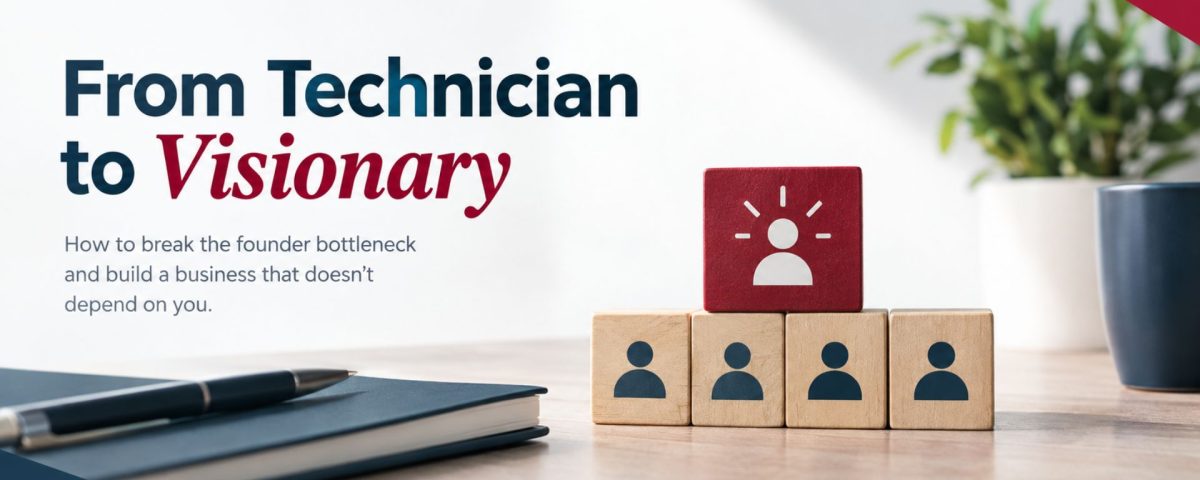
From Technician to Visionary
The practical tools for making this real exist and are widely used across the SMB world for exactly this reason. Gino Wickman’s EOS (Entrepreneurial Operating System), popularized in his book Traction, gives owners a structured way to document processes, hand off decisions with clear accountability, and run disciplined weekly meeting cadences that force the founder to stop being the technician and start being the visionary. The system doesn’t require you to trust people blindly, which is often the real fear underneath the resistance to delegating. It requires you to build the documentation and rhythm that makes trust verifiable — so you can let go of the task without letting go of visibility into whether it’s actually working.
A word for the business you’re building
Whether your company employs five people or five hundred, the trap is identical in shape and only different in scale. In a small or family-owned business, the founder’s grip is deeply personal and emotional — letting go can feel like losing your identity, or like quietly admitting the business doesn’t need you the way you need it to need you. That’s worth being honest with yourself about before you can meaningfully fix the operational side, because no process document solves an identity problem.
Getting Started
Pick one recurring decision that currently requires your personal sign-off — a hiring decision, a pricing exception, a vendor negotiation, a customer complaint escalation. Write down exactly how you make that decision: the questions you ask, the thresholds you use, the judgment calls involved, the things you’re weighing that you’ve never actually said out loud. Then hand the written process, not just the task, to someone capable, and tell them the decision is genuinely theirs now, mistakes included.
This week: document one process you currently hold only in your own head, and delegate it entirely — not “delegate with your approval still required,” but genuinely handed off. Jethro didn’t ask Moses to review the judges’ rulings afterward. He told him to stop being the only judge.