
The Founder’s Trap: Why Your Business Can’t Grow Past You
September 7, 2026Worship Stance
Heart posture, physical posture, and the leader nobody appointed
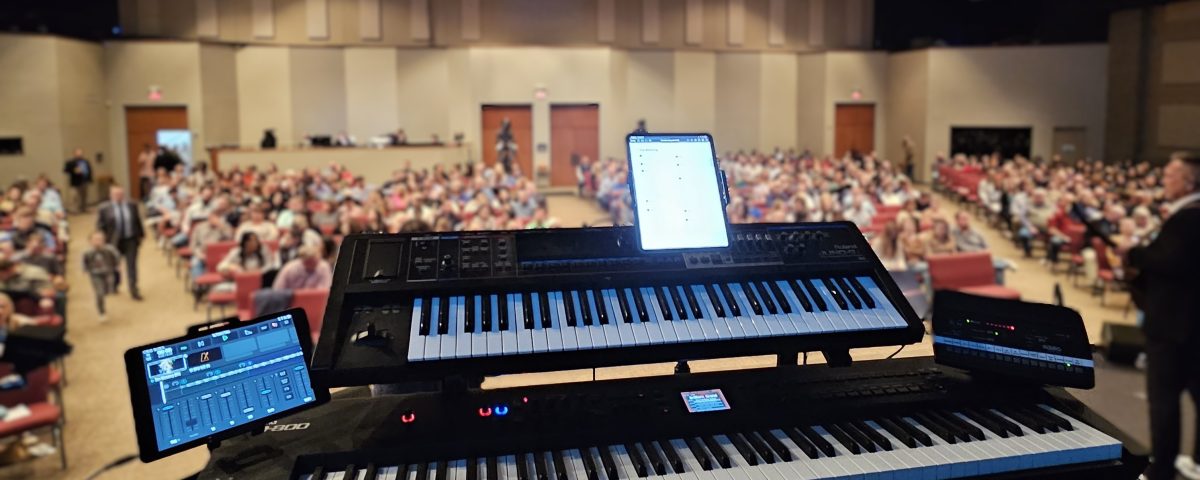
The keyboard player has the hardest seat in the house for this.
The guitar player can step off his mic and close his eyes. The drummer is behind a shield where nobody can see much of anything. The vocalists are facing the room by job description. But keys? Both hands are committed, your eyes are on the chart or the pads or the patch change coming in four bars, and there’s a music stand sitting at eye level like a wall between your face and everybody in the third row.
I play keys in the contemporary band at Harmony Hill Baptist Church. I know what it is to come off the platform on a Sunday and realize I spent forty minutes looking at a screen.
And here’s the thing I keep landing on: nobody appointed me to lead worship, but the room is reading me anyway.
The room is watching whether you asked for it or not
Leadership on a platform isn’t a title. It’s a sightline.
Put a person six feet up and in front of two hundred people, and you’ve made them a leader in that moment regardless of what the bulletin says. The woman on the second row who isn’t sure whether it’s okay to raise her hand in this church is going to look at the platform to find out. The teenager who got dragged in by his mother is going to look at the platform to decide whether any of this is real. They aren’t studying your voicings.
This is the same dynamic that runs a business. Your team doesn’t read your strategy memo for the truth about how things are going — they read your face in the hallway. The face is the memo. Most leaders spend enormous care on the words and almost none on the countenance, and then wonder why the room feels the way it does.
Heart first, and the order is not negotiable
Before a word about posture, the order has to be right, because getting it backwards produces something worse than a flat face.
“Man looketh on the outward appearance, but the LORD looketh on the heart.” And a few books over, the Lord’s own complaint about His people: “This people draweth nigh unto me with their mouth, and honoureth me with their lips; but their heart is far from me.“
A performed worship face is a lie told in a room full of people who came looking for something true. Congregations can smell it. They may not be able to name what’s wrong, but they know when the platform is doing an impression of worship, and it makes them trust everything else less — the songs, the sermon, the invitation.
So the fix for a distracted countenance is never “smile more.” Start upstream. Did I show up prepared, or am I still building patches at 9:50? Did I pray before I plugged in? Is there anything between me and God this morning that I’ve decided to just play through? I can tell you from experience that a man can lead a congregation in *Great Is Thy Faithfulness* while mentally rewriting a proposal. The face knows. It always shows up on the face.
But the body is part of the offering
Here’s where it would be easy to stop, and stopping there is a mistake. “It’s all about the heart” gets used as cover for never letting worship reach the rest of us.
Scripture doesn’t describe worship as an interior event. It describes it with verbs the body does. “O come, let us worship and bow down: let us kneel before the LORD our maker.” “Lift up your hands in the sanctuary, and bless the LORD.” David danced before the Lord with all his might, in front of everybody, and his wife despised him from a window for it. Paul asks for our bodies as a living sacrifice and calls that our reasonable service.
Your posture isn’t decoration on the worship. It’s a piece of it. When your shoulders drop and your head comes up and your hands come off the keys for four bars in the last chorus, something has actually happened in you — that’s not theater, that’s the body catching up with what the heart is already doing.
The goal is a face that tells the truth. If the heart is engaged and the face is buried in a chart, the face is telling a lie too. Just a different one.
The practical part, for musicians
Most countenance problems on a platform are not spiritual problems. They’re preparation problems wearing a spiritual costume. Fix these first:
- Learn the music past the point of reading it. If your eyes are locked to the chart on the final chorus, the answer is another hour with the chart during the week, not another round of guilt on Sunday night. Freedom on the platform is bought in rehearsal.
- Get the stand out of your face. Drop the music stand or the tablet below your sightline. Angle it. You’ll glance down instead of hiding behind it, and glancing down reads completely differently to the room.
- Mark two places in every song where you come up. Write it on the chart if you have to. Turnaround into the bridge, last chorus. Two per song is enough to change the whole set.
- Fix the monitor mix. Nobody worships while they’re straining to hear themselves. If you’re wincing through the set because the mix is wrong, that’s what the room sees, and they’ll read it as something else entirely. Say something at sound check.
- Watch yourself back. If the service gets recorded, watch five minutes of it. Not to criticize your playing — to see what the room sees. It’s uncomfortable and it’s the single fastest correction available.
- Mind the gaps. Between songs is when people actually look at the band. During the song they’re following the lyrics. In the gap, they’re looking at you.
If you lead the team
You can’t coach this by asking for it directly. “Everybody look happier out there” produces exactly the plastic thing you were trying to avoid.
Coach the causes instead. Talk about what everyone’s looking at and why. Rehearse until the charts aren’t load-bearing. Fix the monitors, move the stands, and give your team the theology behind the posture so the change comes from conviction rather than compliance.
And model it, because your team’s countenance won’t rise above yours. If the worship leader plays the whole set with his eyes on the floor, so will everybody else, and no amount of talking about it in the green room will fix what you’re demonstrating on stage.
The audience question
We say we play to an audience of One. That’s right, and it’s worth holding onto — the moment the room becomes your audience, you’ve traded worship for performance and you’ll feel the difference by the second song.
But it isn’t the whole picture. Being reactive to the Father is exactly what the room needs to see. When you respond to Him honestly, in your face and your hands and your posture, you’ve given two hundred people permission to do the same. The congregation isn’t your audience. The congregation is downstream of what you’re doing with your audience.
Aaron’s blessing over Israel was that *the LORD make his face shine upon thee.* We’re not the source of that light. We’re just standing where it lands, and we should probably let it show.
Michal watched David from a window and despised him for how he worshipped. He didn’t adjust. That’s the standard — not indifference to the room, but a heart so fixed on the Father that the room gets the truth whether it likes it or not.
Play the notes. Lift your head.
*Lee Allen Miller is the founder of MSG Resources and the author of* Entrepreneurship God’s Way. *He advises a capped group of owners and executives at connect.msgresources.com/leadership-advisory.*