
Popeyes’ “Dare to Serve” Turnaround
November 2, 2026The 5 Dysfunctions of Your Executive Team
Picture the room. Your leadership team is gathered for the Monday meeting. Someone presents a plan. Heads nod. Nobody pushes back. The meeting ends on schedule, everyone returns to their desks, and within forty-eight hours half the room is quietly working around the decision they just appeared to agree to. No one raised an objection in the room. Everyone had one.
If that scene is familiar, you’re not dealing with a communication problem. You’re dealing with a trust problem wearing a communication costume, and Patrick Lencioni mapped exactly how it happens.
The Pyramid Nobody Wants to Admit They’re On
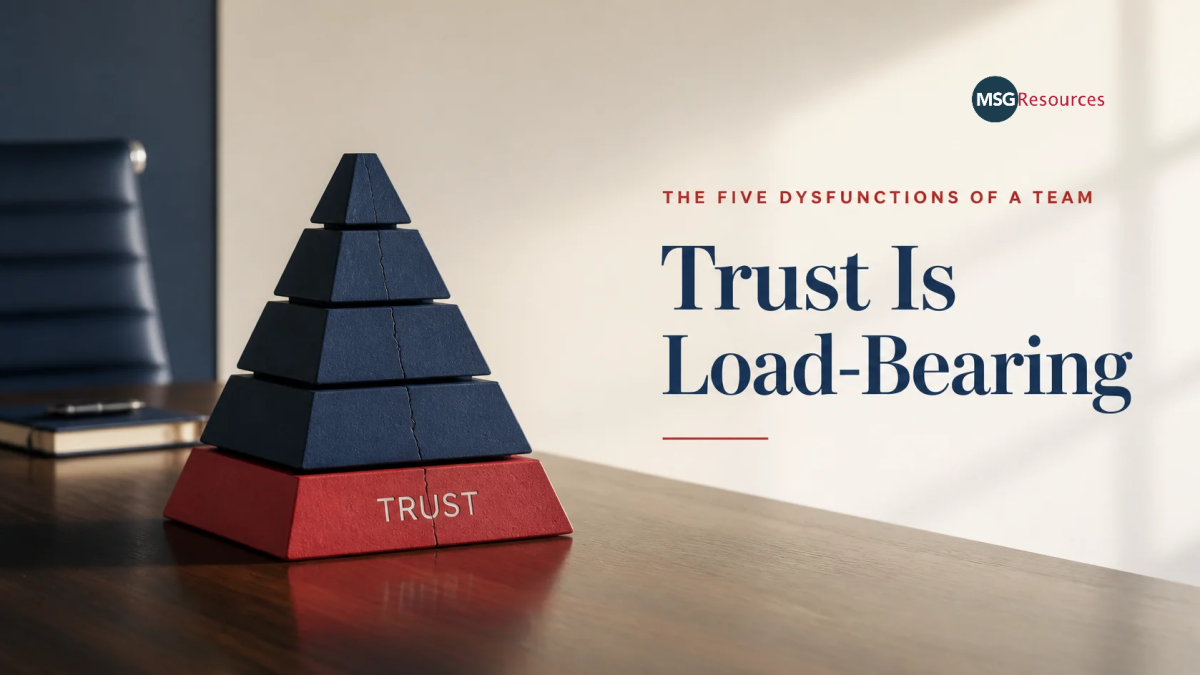
Lencioni’s The Five Dysfunctions of a Team lays out a pyramid — five layers, each one building on the one beneath it, each failure cascading upward into the next. Understanding where your team actually sits on this pyramid is more useful than any offsite you’ll run this year.
- Absence of Trust (the base). Team members are unwilling to be vulnerable with one another — to admit mistakes, weaknesses, or the fact that they don’t have all the answers. Without this foundation, nothing above it can hold.
- Fear of Conflict. Because there’s no trust, the team avoids passionate, honest debate about ideas. Meetings become artificially harmonious. Real disagreement moves to the parking lot and the hallway after the meeting ends.
- Lack of Commitment. Without healthy conflict — the kind where every perspective gets heard and argued through — team members never buy in. Ambiguity persists, and decisions get nodded at, not owned.
- Avoidance of Accountability. Without genuine commitment to a clear plan, team members hesitate to call out peers on behaviors and performance that hurt the team, because nobody is quite sure what everyone actually agreed to in the first place.
- Inattention to Results (the top). Team members put individual needs — ego, career, department turf — above the collective goals of the team, because accountability was never established.
Notice what this pyramid tells you about where to intervene. If your team is avoiding accountability, the fix isn’t a memo about accountability. The fix is several layers down, at commitment, or conflict, or — most likely — trust. Lencioni’s genius is diagnostic: he shows you that the symptom you’re treating is rarely the actual disease.
It’s worth noting that Lencioni built his framework not as an abstract academic model but as a practitioner working with real executive teams, and his work is consistently described as faith-informed — accessible fables built to make organizational health, not just organizational strategy, the point. That distinction matters. Most leadership teams spend the overwhelming majority of their planning time on strategy and almost none of it on whether the team itself is healthy enough to execute that strategy. Lencioni’s whole body of work, including The Ideal Team Player, argues that organizational health is the single greatest opportunity for improvement left in business today — not because strategy doesn’t matter, but because most competitors are already reasonably good at strategy, and almost none of them are good at this.
Why Trust Is the Foundation, Not a Bonus
This lines up with what the research on trust itself tells us. Trust isn’t a vague, feel-good quality — it has identifiable components. The classic Mayer, Davis, and Schoorman model defines trustworthiness through three antecedents: ability (does this person have the competence to do the job?), benevolence (do they genuinely care about my wellbeing, not just their own agenda?), and integrity (do they keep their word and tell me the truth?). When any one of those three wobbles on an executive team, the whole pyramid above it becomes unstable — because trust was never optional. It was load-bearing.
That’s why Lencioni puts it at the base and not somewhere in the middle. You cannot skip to healthy conflict, real commitment, mutual accountability, or shared results by working harder on any of those things directly. You have to go back to trust.
This also explains why so many well-intentioned fixes for dysfunction #4 — avoidance of accountability — fail. Leaders often respond to accountability problems by installing a new performance review process or a stricter reporting structure. That’s a technical fix applied to what is usually a relational problem: nobody on the team is willing to have the direct, sometimes uncomfortable conversation required to hold a peer accountable, because the team has never built the trust that makes direct conversation feel safe rather than threatening. Kim Scott’s Radical Candor framework is useful here precisely because it names the failure mode most teams fall into instead — “ruinous empathy,” where a leader cares about a colleague enough to avoid the hard conversation, which helps no one. Real care and real challenge have to travel together, and they can only travel together on a foundation of trust.
Bearing With One Another
Scripture describes the cost of real unity in terms that sound almost uncomfortable next to the corporate language of “team alignment.” Paul writes: “with all humility and gentleness, with patience, bearing with one another in love, eager to maintain the unity of the Spirit in the bond of peace” (Ephesians 4:2-3, ESV). Notice the phrase “bearing with one another.” Not agreeing with. Not avoiding. Bearing with — a posture that assumes friction, assumes disagreement, assumes imperfection, and commits to staying in relationship through it anyway.
That’s the biblical version of what Lencioni is describing at the “fear of conflict” layer. Unity was never meant to mean the absence of disagreement. It was meant to describe a group of people secure enough in their relationship to disagree honestly and stay bound together anyway. Paul’s description of the church as a body — in Romans 12 and 1 Corinthians 12 — reinforces the same idea: no single person carries the whole picture, which means the team needs every honest voice in the room, not a chorus of nodding heads. An executive team where the CFO never challenges the CEO’s assumptions, or where the head of sales quietly defers to whoever spoke loudest, isn’t a unified team. It’s a team that has mistaken silence for peace.
Where Is Your Team Actually Stuck?
Before you can fix anything, you need an honest diagnosis. Ask your team — or better, ask yourself about your team — these questions, starting from the bottom of the pyramid:
- Trust: Would anyone on this team admit a mistake or a weakness in front of the group, unprompted?
- Conflict: Do disagreements happen in the meeting, or in the hallway after it?
- Commitment: When we leave a meeting having made a decision, does everyone actually believe we made it, or are some people just waiting to see if it sticks?
- Accountability: Will a peer call out another peer’s underperformance directly, or does it always have to come from the top?
- Results: Does everyone on this team measure their own success by the team’s collective outcome, or by their own department’s numbers?
Wherever the honest answers start breaking down is where the real work begins — not at the top of the pyramid, but at that layer.
One Room, Different Stakes
In a large corporate environment, dysfunction on the executive team gets absorbed — for a while — by layers of process, HR structure, and sheer organizational size. A distrustful C-suite can coast on inertia for months before the damage surfaces in turnover numbers or a botched strategic initiative. That doesn’t make the dysfunction less real; it just makes it slower to show up, and often harder to trace back to its root once it does.
In a small or family-owned business, there is no such buffer. When the owner and the two or three people around the table don’t trust each other, everyone in the building feels it within a week. There’s no HR department to paper over unresolved conflict between a founder and a family member who also happens to be a VP. The intimacy that makes small businesses special — everyone knows everyone, decisions move fast — is the same intimacy that makes unresolved trust issues instantly, painfully visible. Fix it at this level and the effects show up just as fast, in the other direction.
This week: In your next leadership team meeting, spend ten minutes on a “personal histories” exercise — go around the table and have each person answer two or three simple, low-risk questions about their background (where they grew up, their first job, a challenge that shaped them). It sounds small. It is the fastest on-ramp to the vulnerability-based trust that everything else on the pyramid depends on.