Stop Brainstorming: What the Research Actually Says About Good Ideas
August 25, 2026
The Founder’s Trap: Why Your Business Can’t Grow Past You
September 7, 2026The Microsoft Miracle: How Satya Nadella Changed Everything
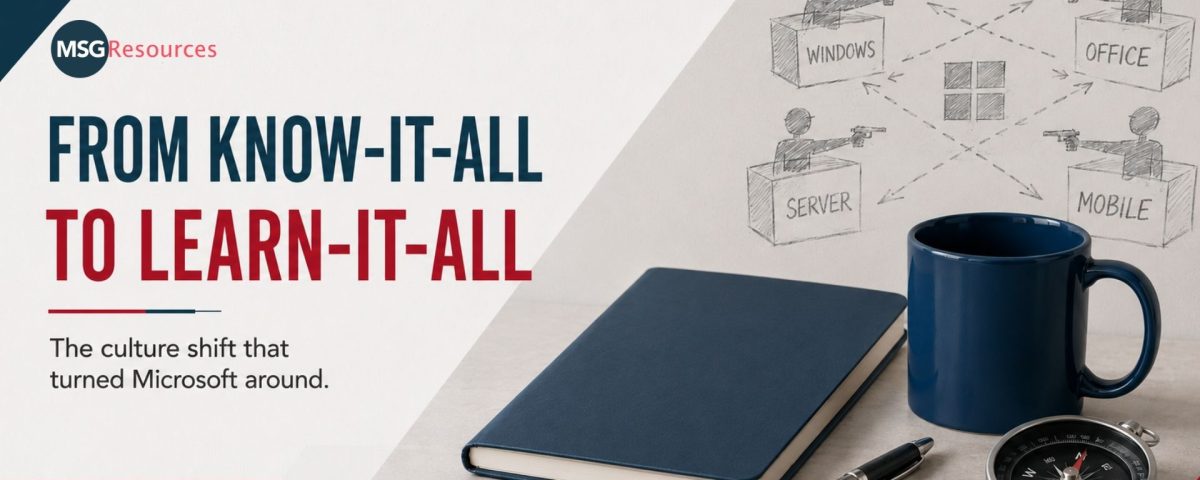
Picture a cartoon that circulated inside Microsoft for years before Satya Nadella ever sat in the CEO’s chair. It shows the company’s org chart redrawn as rival gangs — Windows, Office, Server, Mobile — each division pointing a gun at every other division instead of at the competition. Nobody outside the company drew that cartoon to be cruel. Employees drew it because it was true. By 2014, Microsoft had the talent, the cash, and the market position to dominate mobile computing, and it had watched Apple and Google eat that market for lunch while its own departments were busy defending territory from each other. The problem was never the org chart. The problem was the culture living inside it.
I’ve watched smaller versions of that cartoon play out inside companies I’ve built — real estate teams that wouldn’t share leads across offices, media divisions that hoarded credit for a win instead of sharing it, sales groups that treated other departments like the enemy instead of the ally. It’s a predictable disease, and it has a predictable cause: a culture where looking smart matters more than getting smart. Nadella’s turnaround at Microsoft is the best-documented cure for that disease we have, and it’s worth understanding in detail, because the diagnosis applies whether your company has four employees or four hundred thousand.
The Cutthroat Kingdom
Before Nadella, Microsoft was, by every account in the record, a stagnant, internally competitive monolith. Morale was low. Innovation was stifled by bureaucracy. Stack-ranking performance systems pitted colleagues against each other for a fixed pool of top ratings, which meant helping a peer succeed could cost you your own bonus. The company had missed an entire technological revolution while its people were busy protecting turf instead of building the future. This is what happens when an organization rewards people for already knowing the answer instead of rewarding them for finding it. Smart people stop taking risks. They stop asking questions in front of each other, because a question is an admission you don’t already know, and in a know-it-all culture, not knowing is a liability. They start managing perceptions instead of managing problems, and the gap between what leadership believes is happening and what’s actually happening quietly widens until it becomes a crisis.
From Know-It-All to Learn-It-All
When Nadella became CEO, he didn’t start with a product roadmap. He started with a sentence that has since become one of the most quoted lines in modern management: “Don’t be a know-it-all; be a learn-it-all.” He leaned heavily on Stanford psychologist Carol Dweck’s concept of the growth mindset — the idea that ability isn’t a fixed quantity you either possess or lack, but a capacity that grows through effort, feedback, and honest struggle. In a fixed-mindset culture, mistakes are evidence of inadequacy to be hidden. In a growth-mindset culture, mistakes are data to be examined. That single reframing changes what people are willing to say out loud in a meeting.
Nadella prioritized empathy as an actual leadership discipline rather than a personality trait, broke down the silos that had turned departments into armed camps, and redirected the company’s strategic energy away from defending the legacy Windows monopoly and toward building something new in the cloud with Azure. He reportedly handed copies of Marshall Rosenberg’s book on nonviolent communication to his senior leadership team — not as a gesture of goodwill, but as an operating instruction for how executives were now expected to talk to one another and to their teams. That’s a telling detail. He didn’t just change the strategy; he changed the vocabulary people were required to use while executing it.
The result wasn’t just cultural. Microsoft’s market capitalization more than tripled during his early tenure. The company that had become a punchline for missing the future became, once again, one of the most valuable companies in the world, and it did so by attracting talent that had written the company off a decade earlier. The principle behind the turnaround is worth sitting with, because it inverts how most executives think about the relationship between culture and results: culture transformation drives strategy, not the other way around, and empathy is a hard business imperative — not a soft one you get around to once the numbers are good.
The Proverb Behind the Pivot
Long before Dweck had a name for it, Scripture had already diagnosed the disease Nadella inherited. “When pride comes, then comes disgrace, but with the humble is wisdom” (Proverbs 11:2). Read that verse again with Microsoft’s 2014 org chart in mind. The gun-pointing culture wasn’t ultimately a strategy failure. It was a pride problem wearing a strategy costume. Every executive convinced they already knew the answer, unwilling to be corrected, protecting territory instead of pursuing truth — that’s disgrace waiting for an occasion, and it arrived in the form of a missed mobile revolution. Humility, on the other hand, isn’t weakness, and it isn’t false modesty either. It’s the precondition for wisdom, because you cannot learn what you’re not willing to admit you don’t already know. A learn-it-all culture is, at bottom, a humble culture wearing a corporate badge.
Does Growth Mindset Actually Work?
I want to be honest with you here, because I don’t think you’re served by hype dressed up as research. The academic literature on growth mindset has been humbled somewhat since Dweck’s original work went viral in business circles. Later meta-analyses found the effect sizes of mindset interventions are considerably smaller than the popular narrative suggests — closer to a modest nudge than a magic switch. Growth mindset is not a silver bullet. It will not fix a broken compensation structure, a genuinely toxic team dynamic, or a lack of resources on its own. But that caveat doesn’t undercut Nadella’s real accomplishment — it clarifies it. He didn’t just tell people to believe in themselves harder. He rebuilt incentives, restructured strategy, replaced stack ranking, and modeled the behavior himself, using “growth mindset” as the cultural language for a much deeper operational shift. That’s the difference between a poster on the wall and an actual turnaround, and it’s worth remembering the next time a consultant tries to sell you a mindset workshop as a complete solution.
This is consistent with what Scripture says about growth generally — it isn’t magic, it’s forged through friction, not around it. “Count it all joy… when you meet trials of various kinds, for you know that the testing of your faith produces steadfastness” (James 1:2-4). A learn-it-all culture doesn’t avoid failure or paper over it with positivity. It processes failure honestly, extracts what’s useful from it, and moves forward changed by it.
What This Looks Like on Monday Morning
For those of us running organizations with real P&Ls, here’s how to translate this from case study to practice:
- Change what gets celebrated. If your team only hears praise when things go right, they will hide the things that go wrong. Publicly praise the person who surfaced a mistake early, not just the person who avoided one.
- Model it from the top first. Nadella didn’t ask Microsoft to become humble while he stayed defensive. Admit your own miscalculations out loud, in front of your team, before you ask anyone else to.
- Kill the internal competition that rewards hoarding. If your incentive structure pits departments or individuals against each other for scarce credit, you are manufacturing gun-pointing behavior on purpose, whatever your mission statement says.
- Make learning a standing agenda item. Don’t let “what did we learn” become a slogan on a slide. Put it on the calendar, every week, and treat the answer as seriously as you’d treat a revenue number.
- Reward the question, not just the answer. In meetings, notice who asks the hard question nobody else wants to ask, and make sure that behavior gets reinforced rather than quietly punished.
This week: ask your team directly, in a real meeting, “What did we learn from our last failure?” — and let the silence sit until someone answers honestly. That silence is diagnostic. It will tell you exactly how far you are from a learn-it-all culture.