
The Trust Triangle: Why People Actually Follow You
August 17, 2026Stop Brainstorming: What the Research Actually Says About Good Ideas
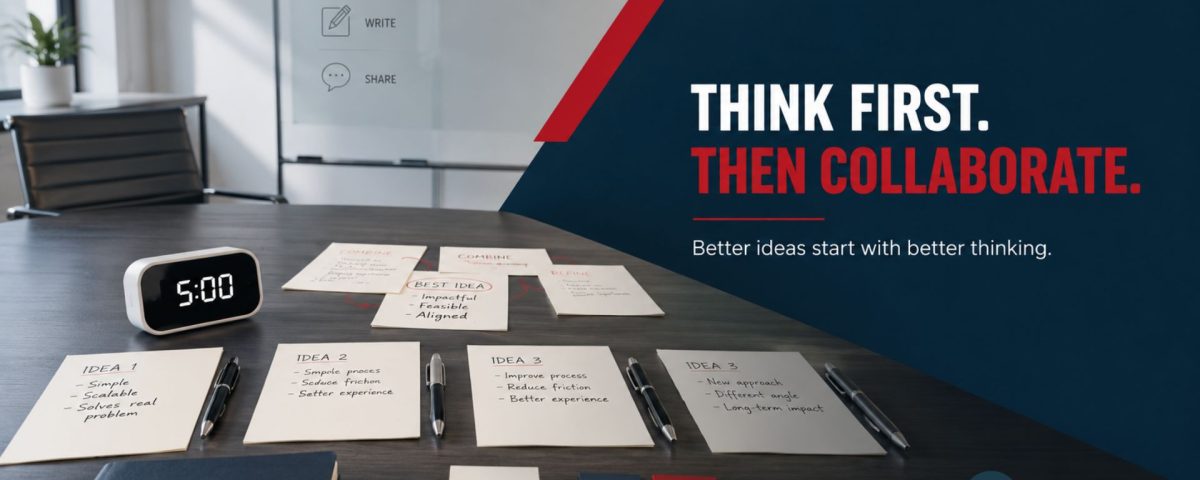
I used to run meetings the way most of us were taught to: throw a problem on the whiteboard, invite everyone to shout out ideas, and call it collaboration. It felt productive. Markers were involved. Energy was high. And for years I assumed the volume of ideas in the room was a decent proxy for the quality of ideas in the room.
It isn’t. And it turns out the research on this has been remarkably consistent for decades, even though almost nobody in business has gotten the memo.
Group brainstorming — the classic, everybody-in-a-room, shout-out-your-ideas format — reliably produces fewer and weaker ideas than the same number of people generating ideas independently and then pooling them. This isn’t a fringe finding; it’s one of the more replicated results in the organizational behavior literature. A few things are working against you the moment you put people in a room and ask them to think out loud together:
- Production blocking. Only one person can talk at a time. While you’re waiting your turn, you’re not generating new ideas — you’re rehearsing the one you’re about to say, and often you’re losing it entirely by the time the floor opens up.
- Evaluation apprehension. Even in a “no bad ideas” meeting, people quietly self-censor the odd, half-formed, possibly-brilliant idea because they’re worried about how it will land with the VP three seats down.
- Social loafing and conformity. Once a few confident voices set the direction, most rooms drift toward agreement rather than genuine divergence — what researchers call “groupthink” isn’t a personality flaw, it’s a predictable outcome of how groups behave under social pressure.
The fix the research consistently points to isn’t “brainstorm harder.” It’s sequence — have people generate ideas silently and independently first, then bring the room together to discuss, combine, and build. Nominal group technique, brainwriting, silent pre-work before the meeting — different names, same underlying principle: protect the individual thinking, then socialize it. I’ve started using a simple version of a technique some facilitators call “6-3-5” — six people write three ideas in five minutes, then pass their sheet to the next person to build on, in total silence, for several rounds before anyone speaks a word out loud. The first time I tried it, I was stunned by how much sharper the ideas were than anything I’d gotten out of an hour of open discussion.
Scripture got there first, in its own way
There’s a proverb that’s stuck with me since I started paying attention to this research: “The heart of the righteous ponders how to answer, but the mouth of the wicked pours out evil things” (Proverbs 15:28). The contrast isn’t really about good ideas versus bad ideas — it’s about pondering versus pouring out. One is reflective; the other is reactive. And while the verse is aimed at speech and character more broadly, the leadership application is hard to miss: the wisest contributions in a room usually come from people who thought before they spoke, not people who spoke the fastest or loudest.
Nehemiah offers a fascinating real-world picture of this principle in action. Before he ever announced his plan to rebuild Jerusalem’s walls, before he ever called the people together, he “arose in the night” and quietly inspected the broken walls himself, alone, telling no one what he was doing (Nehemiah 2:12-16). Only after that private reflection did he bring the people together and cast the vision publicly. He didn’t brainstorm the plan into existence in a crowd. He pondered it in silence, and then he led with it.
I don’t think that’s a coincidence. Scripture consistently prizes counsel over impulsiveness — “where there is no guidance, a people falls, but in an abundance of counselors there is safety” (Proverbs 11:14) — but counsel implies people have actually thought something through, not just reacted in real time to whoever spoke first. A room full of reactive voices isn’t “an abundance of counselors.” It’s an abundance of noise.
What I do differently now
When I need real ideas on a hard problem, I’ve stopped opening with “let’s brainstorm.” Instead:
- I send the question out in advance, in writing, and ask everyone to bring two or three ideas already written down.
- I open the meeting with five minutes of silent writing — even for people who came prepared, new thoughts surface in the room itself.
- Only then do we go around and share, building on what’s written rather than performing off the cuff.
It’s a small procedural change, and it feels less exciting than a whiteboard covered in marker. But the ideas that come out of it are sharper, more varied, and — this is the part that surprised me most — the quieter people in the room, who rarely spoke up in the old format, turn out to have had some of the best ideas the whole time. They just needed room to ponder before they were expected to perform.
The deeper issue: we’ve confused speed with thought
Nobel laureate Daniel Kahneman spent a career studying the difference between what he called System 1 thinking — fast, intuitive, emotional — and System 2 thinking — slow, effortful, and deliberate. A live brainstorm is almost purpose-built to run entirely on System 1. Somebody blurts out the first plausible-sounding idea, the room reacts to it, and momentum carries everyone along before anyone has engaged System 2 at all. That’s fine for genuinely low-stakes decisions. It’s a poor way to solve the problems that actually matter to your business.
I’d go a step further than the research itself and say this is a spiritual discipline question as much as a productivity one. A culture that always rewards the fastest voice in the room is training its people, week after week, to trust reflexes over reflection. A culture that protects a few minutes of silence before every important decision is training its people in something closer to wisdom — the kind Proverbs describes, the kind that ponders before it answers.
A word for both the boardroom and the shop floor
In a large organization, the loudest voice in a brainstorm is very often the most senior person in the room, whether they intend it or not. Silent, written idea generation is one of the simplest ways I know to neutralize positional power in a meeting and actually hear from the people closest to the problem — the frontline manager, the newest hire, the person who’s been quietly right about this for two years and never had the standing to say so out loud.
In a smaller company, where the same three or four people are in every meeting and know each other’s opinions before the meeting even starts, the risk is different: not domination, but a kind of comfortable groupthink where nobody wants to be the one who disrupts the easy consensus. Written, independent idea generation forces even a close-knit team to surface the disagreements they’d otherwise smooth over out of familiarity and fatigue.
This week: before your next meeting where you need real ideas, send the question out ahead of time and ask everyone to bring their thoughts in writing. Open the meeting with five minutes of silence before anyone talks. Watch what changes.