
The 10,000-Hour Rule is a Lie (Sort Of)
October 19, 2026
Popeyes’ “Dare to Serve” Turnaround
November 2, 2026Deciding Before You’re Ready
The decision you keep putting off
If you own an LPTV station right now, there’s a decision sitting on your desk that you’ve been walking around for months. Maybe it’s ATSC 3.0. Maybe it’s what to do about 5G Broadcast. Maybe it’s whether to let AI anywhere near your traffic, billing or programming. You know it’s coming. You just don’t feel ready.
Here’s the hard truth I keep relearning: you’re never going to feel ready. The information you’re waiting for isn’t coming in a neat package. The FCC hasn’t finished deciding the rules. Receiver numbers in your market are a guess. Vendors quote one price in October and another in March. If you wait until the picture is clear, somebody else will have made the decision for you.
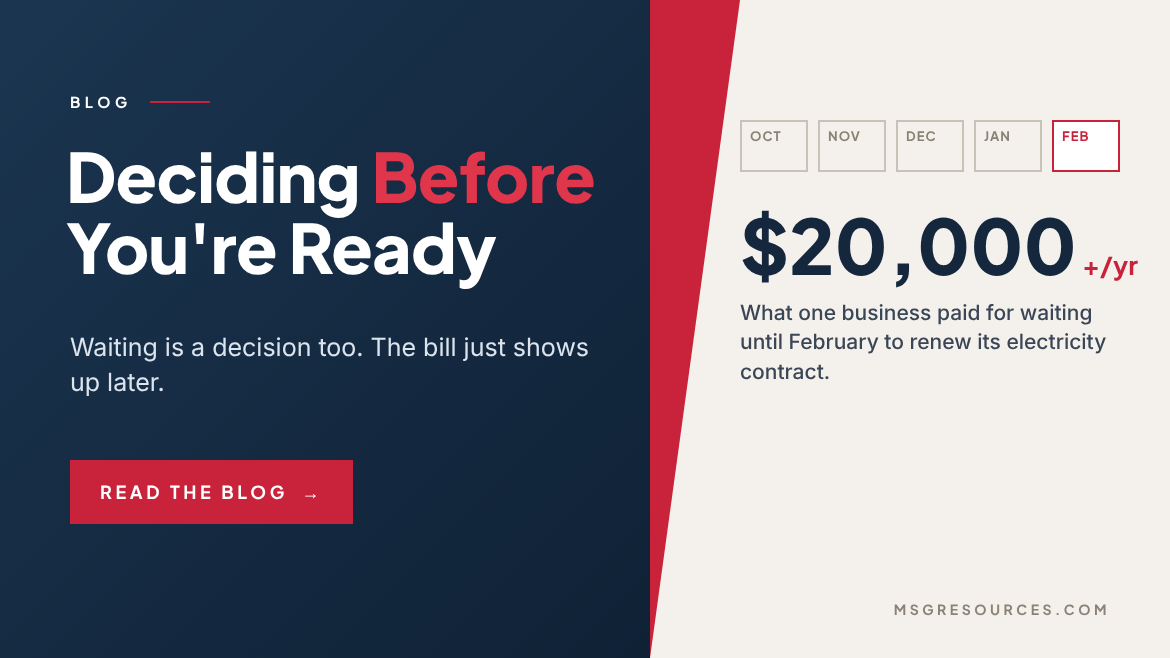
I’m also a partner in Amerigy Energy, an energy brokerage, and I watched this play out last fall. We had a major account whose electricity contract was up for renewal in February. In the fall, we could lock in an extremely competitive rate, and every signal we had said rates were heading up. We urged them to sign. They decided to wait until closer to the renewal date. By February, the market had moved, and the waiting cost them more than $20,000 a year. Nobody on their side made a bad decision that fall. They just didn’t make one, and the market made it for them.
Waiting is a decision too
Waiting feels safe because nothing breaks on the day you wait. No invoice, no outage, no angry viewer. But waiting has a cost. The bill just shows up later, usually after it’s too late to do anything about it.
In our business, that cost shows up as a lighthouse partner who signed with the station down the road. It shows up as a datacasting customer who needed an answer in two weeks and got one in two months. It shows up as an engineer who stopped bringing you ideas because none of them ever went anywhere.
I’m not saying be reckless. Some decisions should wait. The trick is to wait on purpose, with a date and a reason, instead of waiting because deciding is uncomfortable. “We’ll revisit this in March, after we see the FCC’s next move” is leadership. “Let’s see what happens” usually isn’t.
Three habits for deciding without all the facts
1. Separate what you can know from what you can’t. You can’t know when the FCC will rule. You can know your amplifier headroom, your exciter’s upgrade path, and what’s actually inside your contour. Most owners spend their worry on the first list and skip the second. Do the cheap homework first. It shrinks the unknowns down to the ones that really are unknowable.
2. Ask how hard it is to undo. Some decisions are doors you can walk back through. A plant audit, a conversation with a lighthouse partner, a small AI test on one workflow. Make those fast. Other decisions lock you in, like a capital purchase or a contract that runs for years. Slow those down and get a second opinion. The mistake is treating every decision like the second kind.
3. Decide what would change your mind before you decide. Write it down in one line: “If receiver penetration in our market stays under X, we hold. If it passes X, we move.” Now you’re not waiting on a feeling. You’re waiting on a number, and your team knows exactly what you’re watching for.
What to do this month
Pick the one decision you’ve been carrying the longest. Write down three things: what you already know, what you could find out in a week, and the one number or event that would settle it. Then put a date on your calendar to decide.
You don’t need certainty to lead. You need a clear head about what you’re betting on and the nerve to place the bet. The people who work for you can live with a decision that turns out imperfect. What wears them down is a boss who never decides at all.
Our industry is about to make a lot of calls with incomplete information. The owners who come out ahead won’t be the ones who guessed right every time. They’ll be the ones who kept moving.