The Real Reason Your Team Isn’t Engaged (It’s Not the Perks)
August 3, 2026The 2026 Leadership Crisis: Do You Have a Bench?
Every family business owner I’ve ever sat across a table from has, at some point, said a version of the same sentence: “I just need to find somebody I can trust to run this thing.” Usually they say it a decade later than they should have started looking.
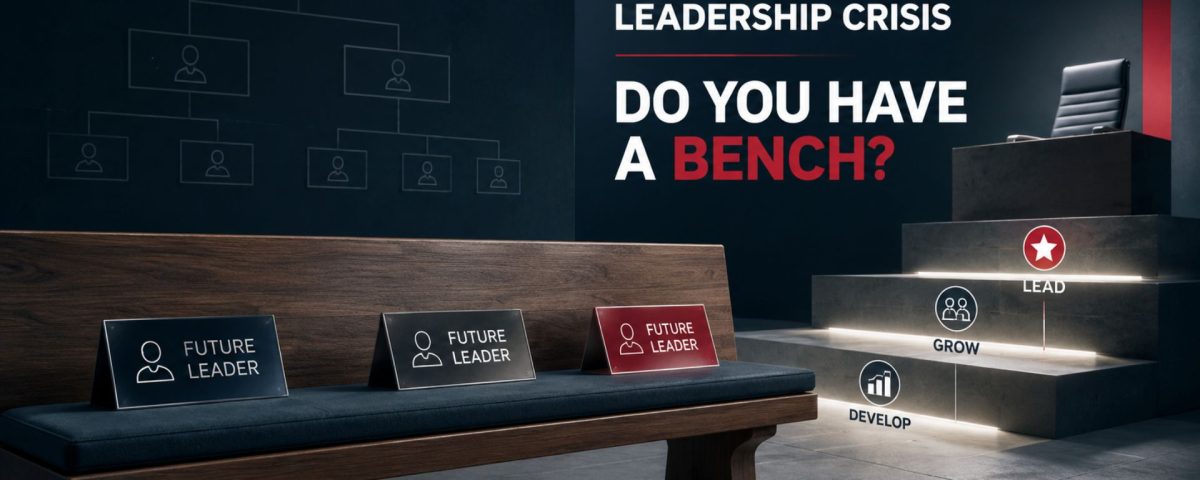
That instinct — the scramble to find a successor after you’ve already needed one — isn’t just an SMB problem. It’s an epidemic at every level of business right now, and the data is sobering. DDI’s Global Leadership Forecast 2025, the largest study of its kind in the world, found that only 12 percent of organizations have confidence in the strength of their leadership bench. Twelve percent. That’s the lowest reading in over a decade of DDI tracking this number, which means nine out of ten companies reading this sentence do not have a credible answer to the question, “Who leads this after me?”
Part of what’s driving this is a trend getting a lot of buzz right now called “unbossing” — flattening organizations, cutting out layers of middle management to save cost and move faster. I understand the appeal on a spreadsheet. But here’s what the spreadsheet doesn’t show you: those middle-management layers were the training ground where future senior leaders learned to lead before the stakes got enormous. Flatten the org chart and you don’t just cut cost — you cut the apprenticeship system your company depended on without ever writing it down.
Meanwhile, the leaders already in the seat are cracking under the weight. DDI reports 71 percent of leaders say their stress has increased, and 54 percent are worried about their own burnout. And the generation coming up behind them is watching closely — and deciding they want no part of it. Deloitte’s 2025 Gen Z and Millennial Survey found that only 6 percent of Gen Z respondents name reaching senior leadership as their primary career goal. They’ve watched their managers get squeezed to the breaking point, and they’ve concluded the corner office isn’t worth what it used to cost. That’s not laziness. That’s a generation doing accurate cost-benefit math based on what they’ve witnessed firsthand.
This is not a new problem. It’s an old one with new data attached.
Scripture actually gives us one of the clearest succession stories in any leadership literature, ancient or modern, in the handoff from Moses to Joshua. Moses had led Israel for forty years — through Egypt, through the wilderness, through more complaining than any of us will ever manage in a lifetime of leadership. And God didn’t let him improvise the ending. In Numbers 27, the Lord specifically instructs Moses to commission Joshua publicly, laying hands on him “before Eleazar the priest and before all the congregation” (Numbers 27:18-23) — a visible, deliberate, unhurried transfer of authority, not a scramble in a hospital room or a hastily called board meeting.
Later, in Deuteronomy 31, Moses charges Joshua directly: “Be strong and courageous… for the Lord your God is he who goes with you. He will not leave you or forsake you” (Deuteronomy 31:6, 8). Notice that Moses doesn’t just hand Joshua a title. He hands him courage, presence, and a theology to stand on. That’s what real succession planning looks like — not a name on an org chart, but a person who has been deliberately built up to carry weight they haven’t carried yet.
Development is a process, not a moment
One framework I’ve come to trust when I think about how leaders actually get built is the “70-20-10” model — the idea that roughly 70 percent of real leadership development happens through hands-on experience, 20 percent through coaching and relationships, and only about 10 percent through formal training and classroom learning. It’s not a precise science, and the exact ratios get debated, but the underlying truth is hard to argue with: you cannot develop your next generation of leaders through an annual seminar. You develop them by handing them real weight, standing close enough to coach them through it, and letting them fail small before they’re asked to succeed big.
That’s exactly the pattern we see with Joshua. He wasn’t handed the nation of Israel cold. He’d already led the fight against Amalek (Exodus 17). He’d already served as Moses’s assistant, present on the mountain, present at the tent of meeting (Exodus 24, 33). By the time Numbers 27 rolls around, Joshua had years of “70 percent” behind him — real experience, under real pressure, with Moses close enough to coach him the whole way.
Why “I’ll figure it out later” is the most expensive sentence in business
I’ve watched this play out both ways — companies that treated succession as a five-year discipline, and companies that treated it as a crisis to be managed the week the founder had a health scare. The first group transitions with barely a ripple. The second group loses customers, key employees, and sometimes the whole business, in the scramble. There is no perfect moment to start; there is only now, and later, which is always more expensive than now.
Here’s the uncomfortable truth: if you don’t have a bench, it’s not because good people aren’t out there. It’s because nobody has been deliberately invested in the way Moses invested in Joshua — named, watched, mentored, and given real responsibility before the crisis forces the issue.
Three moves to make this month
- Name three names. Not a vague sense of “some good people.” Three actual names of people who could grow into a leadership role within 24 months with real investment.
- Give them something real, not a shadow assignment. Real responsibility, real stakes, real feedback — not a “special project” everyone knows doesn’t matter. That’s your 70 percent.
- Say it out loud. Moses commissioned Joshua publicly. Ambiguity about who’s being developed breeds insecurity and gossip. Clarity, even imperfect clarity, builds trust.
A word for both the corner office and the family business
If you’re running a large organization, the “unbossing” pressure is coming from a spreadsheet — cut layers, cut cost, move fast. My challenge to you isn’t to reject flattening outright; sometimes it’s the right call. It’s to ask what you’re doing to replace the training ground you just removed. A flatter chart demands more intentional development, not less, because you’ve eliminated the layers where people used to learn by osmosis.
If you’re running a family business or an owner-operated company, your version of this crisis usually has a name and a face — a son, a daughter, a longtime employee you’ve quietly wondered about but never actually asked. The DDI and Deloitte numbers are sobering at the macro level, but at your scale, the fix is almost embarrassingly simple by comparison: have the conversation you’ve been avoiding. Paul’s charge to the Ephesian church captures the whole spirit of this — leaders exist “to equip the saints for the work of ministry, for building up the body of Christ” (Ephesians 4:12). Your job was never to be the last competent person standing. It was always to build others who could stand without you.
This week: identify three high-potential leaders in your organization and schedule a real mentoring conversation with each of them before the month is out. Twelve percent of companies have a bench. Decide now which side of that statistic you’re going to be on.