
The Meeting After the Meeting
May 28, 2026Hard Conversations, Held Well
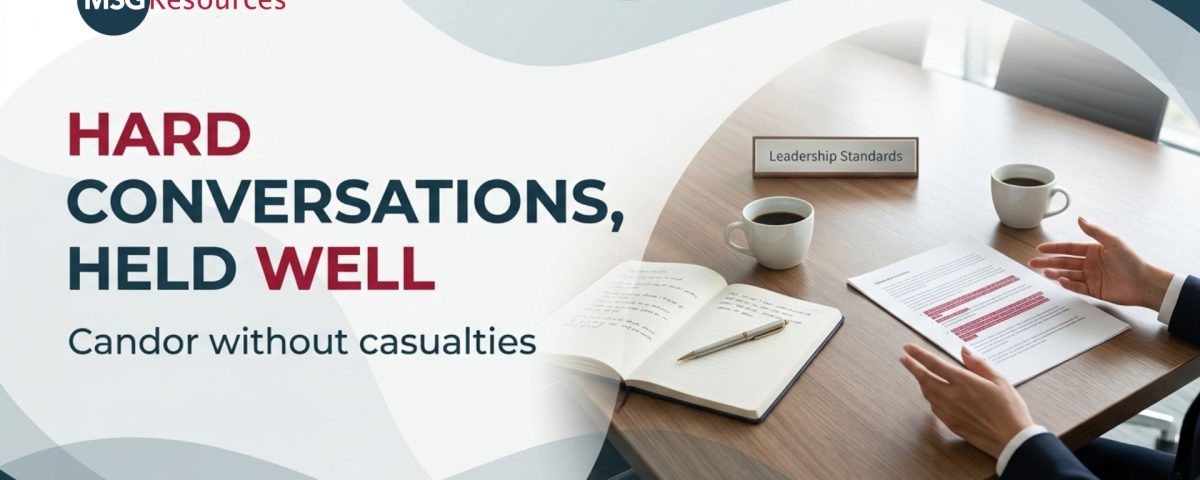
Candor without casualties
Most leaders are either good at hard conversations or good at relationships. The rare leader is good at both, and the reason the combination is rare is that most of us were taught, implicitly, that they are in tension. You either tell people what they need to hear and risk the relationship, or you protect the relationship and let the truth get softer than it should be. A whole career can pass under that false choice.
The leaders who last, and whose organizations last, have learned a different way. They have learned that a hard conversation, held well, strengthens the relationship rather than threatening it. And the ones who avoid hard conversations — out of kindness, they tell themselves — are not being kind. They are trading short-term comfort for long-term damage, and the people underneath them can feel the difference.
“The conversation you do not have is the conversation you are having, silently, in everyone’s behavior.”
Three principles for holding a hard conversation well
1. Decide what the conversation is actually about
Most hard conversations go poorly because the person initiating them has not decided what the conversation is really about. Is it about a specific behavior that needs to change? Is it about a pattern that has accumulated? Is it about a mismatch between the role and the person? Is it about your own loss of confidence in their judgment? These are different conversations, and conflating them turns a hard conversation into a confused one. Before you open your mouth, write one sentence that names the real subject. If you cannot name it clearly, you are not ready to have it.
2. Lead with the standard, not the person
The tone of a hard conversation depends almost entirely on what it is anchored to. Anchor it to the standard the role requires, the outcome the work demands, the commitment the person made when they took this on — and the conversation becomes about a gap between performance and expectation, which is the kind of conversation a professional can have. Anchor it to the person’s character, their effort, or your dissatisfaction with them, and it becomes personal, defensive, and rarely productive. The standard is neutral ground. Use it.
3. Ask before you conclude
A hard conversation that is all transmission is almost never received well. Leaders who hold these conversations best treat them as exchanges, not verdicts. After you have stated the concern clearly and without hedging, ask. “How are you seeing this?” “What am I missing that you would want me to know?” “What would a real path forward look like from where you sit?” You may learn something that changes your view. You may not. Either way, the other person has been treated as an adult whose perspective matters, which is the precondition for any conversation that is going to produce real change.
Leadership Reflection
• Which hard conversation on your desk right now has been waiting too long? What is the real subject, stated in one sentence?
• When you last had a hard conversation, did you anchor it to the standard or to the person? What was the difference in how it landed?
• Who in your organization has been treated to silence instead of honesty, and what is that silence quietly teaching them?
The kindness of saying it clearly
The hardest thing about hard conversations is not the conversation itself. It is the decision to have it. Once the decision is made, the rest is technique, and technique can be learned. The decision, though, is an act of character. It reflects what you believe about the person — whether you believe they are capable of hearing the truth and responding to it, or whether you have quietly given up on them. The way you treat them when it is easiest to avoid them is the clearest signal of which view you actually hold.
Kind leaders say the hard thing. Unkind leaders let the person keep failing in the dark.
____________________________________________________________
Stuck on a decision that matters? That’s what the MSG Resources Leadership Advisory is built for — a private, invitation-oriented space for senior leaders who need clarity on the decisions that shape everything else. Learn more at connect.msgresources.com/leadership-advisory.