
Most of Us Don’t Want Counsel. We Want Agreement.
September 28, 2026The AI Manager: What Happens When Your Boss is a Bot?
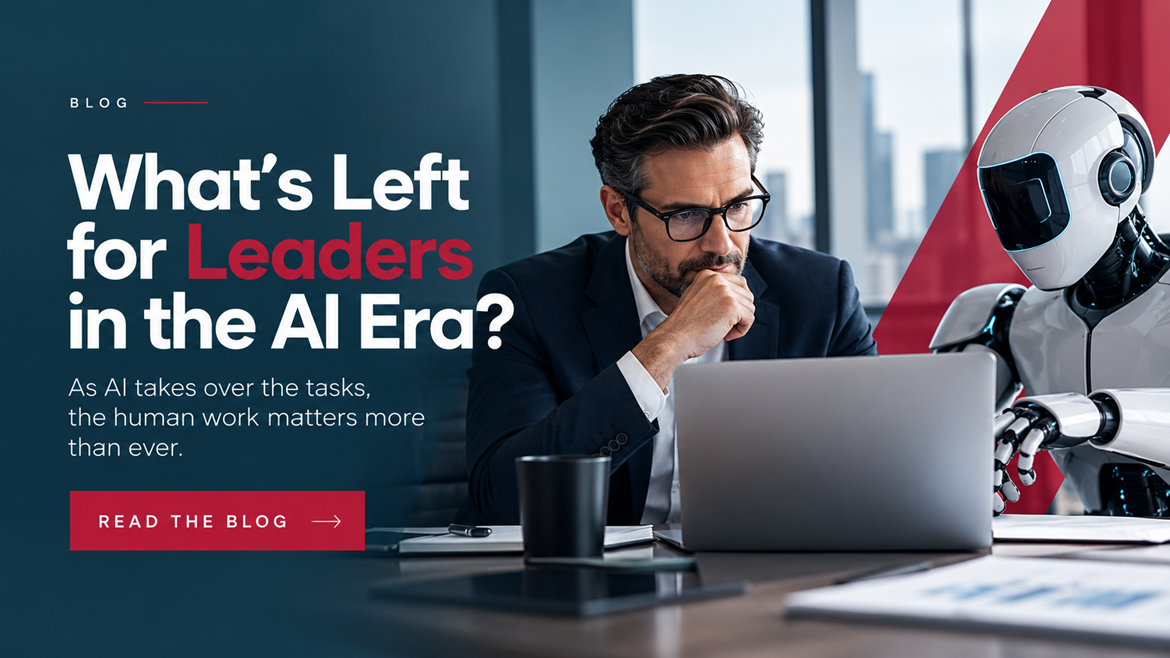
It’s Monday morning. Your quarterly numbers are summarized before you’ve had coffee. A draft of your board update is sitting in your inbox, already written, already formatted, already citing the right comparisons from last quarter, already anticipating the two questions your CFO always asks. None of it took a human more than a few seconds of typing to produce. If you’re running a company in 2026, some version of this is already your reality, and it’s only going to get more complete over the next eighteen months. So here’s the uncomfortable question underneath the convenience: if a machine can write the report, analyze the data, and draft the summary faster and more accurately than your best analyst, what exactly are we still paying managers to do?
The Rise of the Frontier Firm
Microsoft’s 2025 Work Trend Index gives this shift a name: the “Frontier Firm” — organizations fully integrating AI and building hybrid teams of humans and AI agents working alongside each other as genuine collaborators rather than tools. This isn’t a speculative trend hovering somewhere on the horizon. According to that same research, 81% of leaders expect AI agents to be moderately or extensively integrated into their strategy within the next 12 to 18 months. That’s not a pilot program tucked away in an innovation lab. That’s a structural change to what a “team” even means, arriving inside a single budget cycle, whether your organization is ready for it or not.
If you lead people, this should not make you anxious about your own job so much as it should make you precise about what your job actually is. A huge share of what has traditionally filled a manager’s day — pulling data, formatting reports, summarizing meetings, drafting first versions of documents, scheduling and reconciling — is exactly the kind of structured, repeatable, information-processing task that generative AI is built to absorb efficiently. That work is disappearing as a manager’s core value-add, and no amount of nostalgia for the old way of doing things will slow it down.
This lands on top of a workforce that was already struggling before AI entered the picture. Gallup’s most recent data puts global employee engagement at just 20%, and manager engagement itself has actually been dropping — from 27% down to 22% in a single year. Layer an AI transformation on top of an already-disengaged management layer, and you get a genuinely dangerous combination: leaders who were already checked out, now also uncertain whether their role still has a purpose. The organizations that will win this transition aren’t the ones that adopt AI fastest. They’re the ones whose managers can articulate, with total clarity, what only a human being sitting in that seat can still provide.
So What’s Left for Us?
What doesn’t go away is everything AI cannot do, and the list is longer and more distinctly human than it might first appear: judgment under genuine uncertainty, empathy toward a struggling employee having a hard season, trust-building over years of consistent behavior, complex conflict resolution between two people who each sincerely believe they’re right, and meaning-making — helping a team understand why their work actually matters, not just what it technically accomplished. As AI takes on the analytical and administrative load, these uniquely human elements don’t become optional extras you get to if there’s time left over. They become the entire job description. The leader of a Frontier Firm doesn’t manage tasks anymore, because the tasks increasingly manage themselves. They manage the interface between human judgment and machine capability, deciding what should be automated and what must never be, and that requires a different, deeper skill set than most management training programs have ever actually taught.
Leading with the Image of God
There’s a theological anchor here that secular management literature can gesture toward but never quite name with precision. The concept of the imago Dei — humanity made in the image of God — reminds us that people possess inherent dignity, moral agency, and creative capacity that no machine, however capable, can replicate or replace, regardless of how convincing its output becomes. An AI can pattern-match a thousand performance reviews and draft plausible language for all of them in seconds. It cannot sit with a grieving employee. It cannot discern when a “yes” from a direct report actually means “I’m afraid to say no to you.” It cannot bear the weight of a genuinely hard decision the way a human being made in God’s image bears it — with conscience, with accountability, with soul, with the capacity to lie awake over it. Leadership in the AI era is not primarily a technology question, however much it looks like one on the surface. It’s a stewardship question: will we use these tools to free our people for more human work, or will we let raw efficiency quietly erode the parts of leadership that were never meant to be efficient in the first place?
This same era has already forced leaders to get more intentional about a related question: where does connection actually happen now that so much work is distributed and increasingly automated? The research on hybrid work is clear that flexibility itself isn’t the threat to culture that many executives feared — hybrid schedules reduce quit rates significantly with no meaningful loss in productivity — but “proximity bias,” the unconscious tendency to favor whoever happens to be physically present, is a real threat, and it will only get worse as more of the routine work moves to AI agents nobody can see in the hallway. The leaders who get this right are designing their limited in-person and synchronous time deliberately around the human work — mentoring, hard conversations, genuine relationship-building — rather than around status updates a bot could have generated on its own.
It’s worth saying directly what this means for how you spend your own time as an executive. Every hour you claw back from report-writing and data-pulling is an hour you get to reinvest in exactly the things a Frontier Firm still needs a human being to do. That reinvestment doesn’t happen automatically just because the AI freed up the hour. It happens because you decided, on purpose, that the freed-up time belongs to your people and not to your inbox.
Where to Double Down
For executives building strategy around this shift, the priority list should look something like this:
- Judgment. Invest in your own and your leaders’ ability to make sound calls with incomplete information — this doesn’t get outsourced to a model, no matter how good the model gets.
- Empathy. Protect the time and attention it takes to actually notice how your people are doing, not just what they produced this week.
- Trust-building. Relationships built over time, kept through consistency and follow-through, cannot be automated into existence overnight.
- Meaning-making. Someone still has to explain why the work matters to the person doing it. That will never be a task for a machine, no matter how articulate it becomes.
None of this requires you to resist the technology or slow-walk adoption out of nostalgia. It requires you to be clear-eyed about which parts of your job were always going to belong to a human being, no matter how the tools around you changed, and to guard those parts deliberately rather than letting them get crowded out by whatever’s easiest to measure.
This week: look honestly at your calendar and identify one task an AI tool could fully absorb by next month — then reinvest the hours you reclaim directly into one of the four human skills above, on purpose, not as an afterthought once everything else is done.