The 5 Dysfunctions of Your Executive Team
November 2, 2026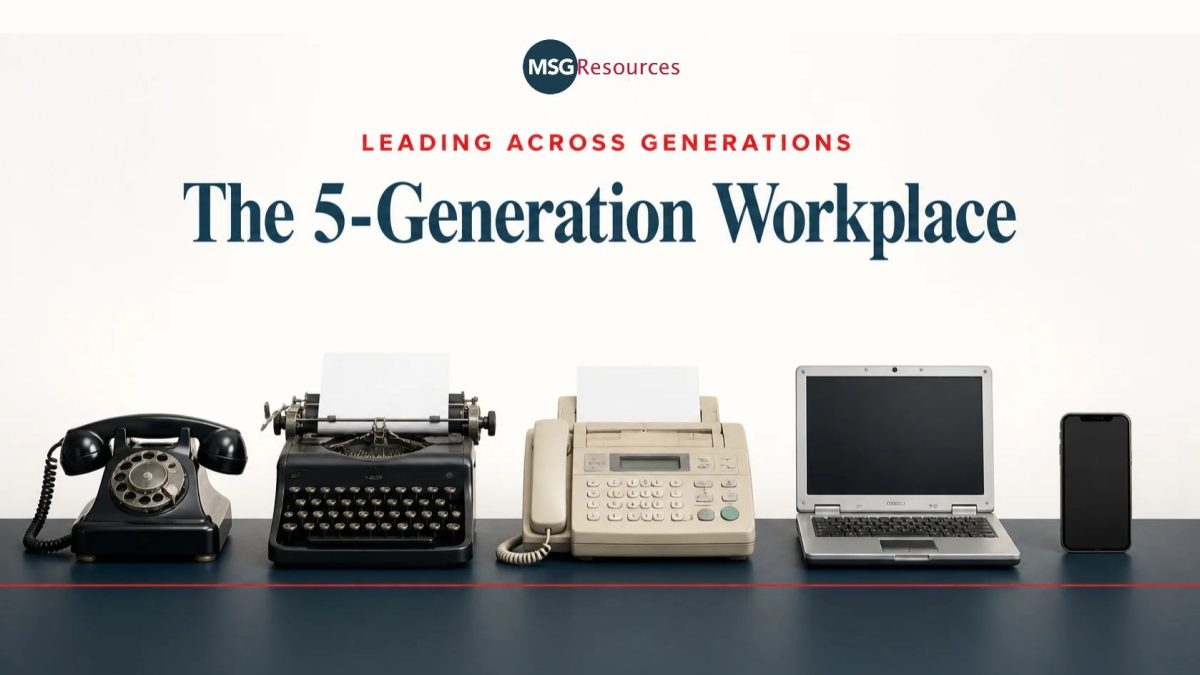
Walk into almost any conference room today and you might be looking at a Traditionalist who remembers rotary phones, a Baby Boomer who built her career before email existed, a Gen Xer who came up during the fax machine, a Millennial who grew up alongside the internet, and a Gen Z employee who has never known a world without a smartphone in his pocket — all reporting into the same meeting, on the same project, expected to somehow speak the same language. For the first time in the history of the workforce, five generations are working side by side. I’ve seen the confusion this creates firsthand across the businesses I’ve been part of building — the well-meaning older manager who reads a Gen Z employee’s silence as disrespect, and the equally well-meaning young hire who reads the manager’s formality as coldness, when neither one meant anything of the sort.
Most leaders respond to this by reaching for generational stereotypes — the tired jokes about Boomers and technology, or Gen Z and work ethic. That’s the wrong tool for the job. The generations sharing your office right now aren’t a problem to be managed with a punchline. They’re an asset that most organizations are leaving completely untapped.
Five Generations, One Table
The generational mix in today’s workforce spans Traditionalists, Baby Boomers, Generation X, Millennials, and Generation Z. Each generation entered the workforce under different economic conditions, different technologies, and different cultural expectations, and each brings something the others genuinely lack. The newest entrants, in particular, are reshaping expectations around transparency, mental health support, ethical corporate behavior, and values alignment — not because they’re more demanding, but because they were formed by a different set of formative events than the generations before them.
The instinct to treat this as friction to be minimized misses the actual opportunity. A team with five generations in it has more collective pattern-recognition, more varied life experience, and more perspective on both “how we’ve always done it” and “how it could be done differently” than a team of any single generation ever could.
There’s real pressure underneath this shift, too. Leadership pipeline research shows that only 6% of Gen Z workers cite reaching a senior leadership position as a primary career goal, and leaders across the pipeline report significant burnout — 71% report increased stress, and 54% are actively concerned about burning out. That combination should worry every executive reading this: the generation entering the workforce right now is watching the generation ahead of it burn out in leadership roles, and concluding the job isn’t worth it. If you want your younger employees to eventually want your job, you have to demonstrate — visibly, over time — that the job is survivable and worth wanting. That’s a generational trust problem as much as it is a staffing problem.
Understand What Formed Each Generation
Generational friction usually isn’t about values at the deepest level — it’s about formation. Traditionalists and Baby Boomers were largely formed by institutions that rewarded loyalty, hierarchy, and long tenure. Generation X came of age amid economic instability and learned self-reliance early. Millennials entered the workforce during the 2008 financial crisis and watched institutional promises break in real time. Gen Z has never known a workplace without instant information, and they’re entering it during a period of declining institutional trust across the board — government, media, and, increasingly, employers who say one thing and do another. None of these formative experiences are wrong. They’re just different lenses, and a leader who understands the lens someone is looking through can translate far more effectively than one who simply labels the behavior “difficult.”
Reverse Mentoring: Wisdom Flows Both Ways
The most effective response I’ve seen to this dynamic is reverse mentoring — a structure where younger employees mentor senior leaders on technology, social trends, and cultural shifts, while senior leaders offer wisdom, institutional memory, and strategic context in return. This isn’t a gimmick to make older executives look approachable. It’s a genuine two-way transfer of value that most hierarchical organizations are structurally bad at facilitating on their own, because information in a traditional org chart only flows one direction: down.
Reverse mentoring forces it to flow both ways. The senior leader learns something real about how younger employees actually think and work. The younger employee gains access to judgment, context, and organizational history that no amount of natural talent can substitute for. Done well, it builds mutual respect in both directions instead of the quiet mutual condescension that too often defines cross-generational relationships at work.
I’d argue this is the single highest-leverage, lowest-cost intervention available to a multigenerational organization right now. It doesn’t require a new HR platform or a consulting engagement. It requires putting two people who wouldn’t naturally sit across a table from each other in a room, on purpose, with a specific reason to actually listen. Most organizational silos — including generational ones — survive on nothing more than the absence of a structured reason to talk.
Honoring the Old and the Zeal of the Young
Scripture has always assumed a workplace — a household of faith — with multiple generations in it, and it never treats that as a problem to solve. Titus 2 lays out mutual instruction across age groups: older believers are called to model soundness in faith, love, and steadfastness, and to actively teach what is good; younger believers are called to receive that instruction with humility while bringing their own energy to the mission. Paul’s charge to Titus himself — a young leader — captures the balance precisely: “Show yourself in all respects to be a model of good works” (Titus 2:7, ESV). Youth was never a disqualification from leadership in Scripture; it was a call to earn credibility through conduct.
Elsewhere, Paul tells Timothy directly: “Let no one despise you for your youth, but set the believers an example in speech, in conduct, in love, in faith, in purity” (1 Timothy 4:12, ESV) — a command aimed squarely at older believers not to dismiss a younger leader’s contribution. And Leviticus reinforces the other direction of the same respect: “You shall stand up before the gray head and honor the face of an old man” (Leviticus 19:32, ESV). Neither instruction cancels the other out. Both are commanded, simultaneously, because a healthy community — like a healthy workplace — needs both the wisdom of experience and the zeal of youth, and neither generation is permitted to write the other off.
Practically, this means a leader over a multigenerational team has two jobs happening at once, not one. You have to actively protect younger voices from being dismissed on the basis of age alone, and you have to actively protect the accumulated wisdom of your longest-tenured people from being treated as irrelevant just because it’s not the newest idea in the room. Most organizations default toward one of these failures without noticing — either an unspoken gerontocracy where nothing new gets tried, or a youth-obsessed culture that quietly stops listening to the people who’ve already lived through the mistakes being repeated.
Big Company, Small Shop
In a large corporate environment, generational friction tends to show up structurally — in rigid promotion timelines that assume everyone wants the same traditional career ladder, in benefits packages designed for one era’s family structure, or in communication norms (all-email, all-formal) that alienate younger employees without anyone intending it. The fix usually requires deliberate policy: building reverse mentoring into formal development programs, and training managers explicitly to lead across generational lines rather than assuming their own generation’s norms are universal.
In a small or family-owned business, the generational mix often plays out at the literal family table — a founder in his sixties working alongside a daughter in her twenties who’s stepping into the business with entirely different instincts about technology, marketing, and pace. There’s no HR department to formalize a reverse mentoring program here; it has to happen relationally, over actual conversation, with both generations extending the other the benefit of the doubt. The stakes are different, but the fix is the same instinct: sit down and actually trade what you know.
This week: Pair a younger employee with an older one — ideally two people who don’t naturally cross paths — for a two-way mentoring coffee. Give each of them one thing to teach the other. Let the wisdom and the zeal trade places for thirty minutes and see what happens.