
The People You’re Developing (Or Aren’t)
June 12, 2026
Leading Through Seasons of Pressure
June 23, 2026Culture Is What You Tolerate
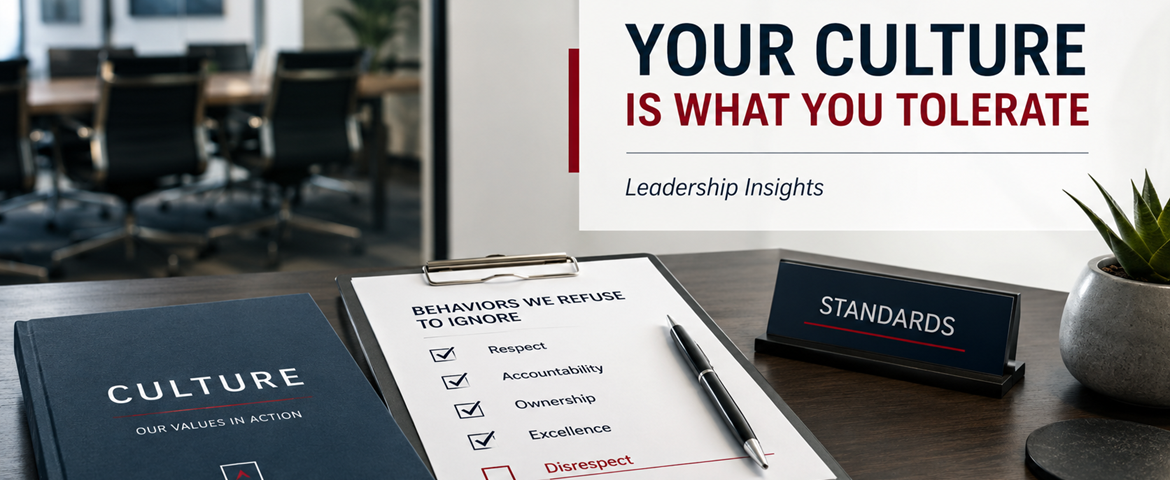
The quiet signals that shape what your organization actually believes
Every organization has a culture statement and a culture. The first is on the website. The second is what people actually do when no one is forcing them to. When the two diverge, the second wins, every time. And the second is shaped less by what you celebrate than by what you are willing to walk past.
Leaders almost always overestimate the impact of what they reward and underestimate the impact of what they tolerate. The poster on the wall says “excellence.” The meeting that ran twenty minutes long with no decision says something else. The team is reading both signals. They have learned, correctly, that the second one is the truer one.
“Your culture is not what you say. It is the worst behavior you are willing to live with.”
Three principles for shaping culture by what you stop tolerating
1. Audit what you walk past
Spend a week paying attention to the behaviors you notice and choose not to address. The meeting that started late again. The peer who undermined another peer with a quiet aside. The standard that slipped, that you decided not to make a thing of. Each of those choices is a teaching moment, whether you intended it as one or not. Write them down. The list will tell you, with uncomfortable accuracy, what your culture actually is. Not what you wish it were. What it is.
2. Address the small things, not just the large ones
Leaders save their courage for the big confrontations and let the small things slide. The opposite is wiser. Big confrontations come with their own clarity — everyone knows what just happened. Small tolerations accumulate invisibly, and by the time they are large enough to address, they have become the culture. Catch them small. The thirty-second redirect you offer in the moment is worth more than the difficult conversation you would have had to have six months later.
3. Hold yourself to the same standard you hold others to
Nothing erodes culture faster than a leader who applies a standard to the team that they exempt themselves from. If you require punctuality, be punctual. If you require directness, be direct. If you ask for ownership of mistakes, own yours publicly when they happen. The team is reading you constantly, and the gap between what you ask and what you model is the actual ceiling on the culture you can build. Close the gap, and the ceiling rises. Tolerate it in yourself, and there is no version of leadership rhetoric that will overcome it.
Leadership Reflection
• What did you walk past last week that, if you had stopped and addressed it, would have shifted your culture by a small but real degree?
• Where are you holding the team to a standard you would not pass if applied to yourself?
• What is the worst behavior currently happening regularly in your organization that has gone unaddressed long enough to be considered normal?
The slow accumulation that becomes “how we do things”
Culture is not built in retreats or rebranded in offsite workshops. It is built in the dozens of micro-decisions a leader makes every week about what to address and what to let slide. The leaders whose organizations have the strongest cultures are not louder, more charismatic, or more aspirational than their peers. They are simply more willing to engage with the small things, in real time, before the small things accumulate into the things they used to think they would address one day.
If you want to know what your culture believes, do not read the values statement. Watch what you let go this week. That is the actual document, written in conduct, signed by your silence.
____________________________________________________________
Stuck on a decision that matters? That’s what the MSG Resources Leadership Advisory is built for — a private, invitation-oriented space for senior leaders who need clarity on the decisions that shape everything else. Learn more at connect.msgresources.com/leadership-advisory.